Here's the thing nobody tells you about meal prep for families: the cooking is the easy part. The hard part is doing it alone. One person plans the week, shops for it, spends Sunday afternoon filling containers — and then hears "I don't want that" from across the table on Tuesday. No container set, no color-coded chart, and no family meal planning app will fix that on its own, because the problem was never the prep. It was that the prep belonged to one person.
Family meal prep works when it belongs to the household. That doesn't mean your six-year-old is running the stove. It means everyone has a say in what gets made, a real job, and a way to see the plan without asking you.
Why Family Meal Prep Falls Apart When One Person Does It All
One parent keeps the meal ideas in their head, writes the list, does the shopping, and preps everything on Sunday. It works beautifully for a few weeks.
Then the planner gets tired of being the only one who cares. The rest of the family, who had no part in choosing the meals, starts treating dinner like a restaurant where the kitchen keeps getting the order wrong. And when the planner has a brutal week, there's no backup — everyone is back to the 5:30 PM fridge stare.
The fix isn't a more disciplined planner. It's spreading the work out so the plan survives a bad week, and spreading the decisions out so people actually eat what gets cooked.
Start With a Ten-Minute Household Huddle
Pick one calm time each week — Saturday morning over coffee, Sunday after lunch — and get everyone in the same room for ten minutes. Not an hour. Then you're done.
Look at the week first. Who has practice Tuesday? Late meeting Thursday? Those nights get the slow cooker or the leftovers — nothing kills a plan faster than a 45-minute recipe on the one night nobody gets home before seven.
Everyone names one meal. You get a vote, and your vote gets cooked. Kids who picked Wednesday's tacos are invested in Wednesday's tacos. If a pick is wildly impractical, help narrow it down ("pancakes for dinner" is a perfectly good Thursday) instead of vetoing it.
Fill in the gaps, then stop. Four or five dinners is plenty. Leave a night for leftovers and a night that's nobody's problem. New to this? Our guide to meal planning for a family of four covers the basics.
Give Everyone a Job They Can Actually Do
Meal planning for families breaks down when "helping" means standing around while one adult does everything. Match jobs to ages and a lot more gets done.
Little kids (roughly 3 to 6)
- Washing produce — a colander and a step stool. They will take it very seriously.
- Tearing lettuce and snapping green beans — no knife needed, real contribution.
- Counting snacks into containers — ten crackers, five baby carrots. Prep and math practice at once.
Big kids (roughly 7 to 12)
- Peeling and measuring — carrots, potatoes, cups of rice. Give them a peeler and a target.
- Assembling — mason jar salads, wrap kits, egg muffin tins. Set out the ingredients and let them build.
- Labeling — painter's tape and a marker: what it is, what day it's for. It matters more than it sounds.
Teens
- Own one dinner a week, start to finish — choose it, add what they need to the list, cook it. Sheet pan meals and pasta are forgiving starts.
- Batch cook a protein — shredded chicken or a pound of browned turkey on Sunday feeds half the week.
- Do the grocery run — once they drive, this is the most useful job in the house.
Partners
Split by strength, not down the middle. If one of you likes shopping and the other likes cooking, one owns the list and the store and the other owns the prep. Or one preps on the weekend and the other handles weeknight assembly. Either way, the plan doesn't live in one head.
Let the Kids Rate Every Meal
This is the most effective trick for picky eaters, and it costs nothing. After dinner, everyone rates the meal — thumbs up or down, one to five stars, a sticker chart on the fridge. Then you actually use the ratings.
Meals that score well go into the rotation. Meals that bomb don't come back, or come back with a tweak ("same tacos, no onions"). Within a couple of months you have fifteen or twenty dinners your household genuinely likes, and the huddle gets faster because you're choosing from winners.
A child who gave last week's chicken stir-fry four stars is a lot less likely to refuse it this week — they're on record. In MealHuddle, that's what Little Chefs is for: kids get their own kid-friendly screen where they rate the meals on the plan, so their votes land alongside everyone else's instead of on a sticky note.
Prep Together, Not Alone
With a plan and assigned jobs, Sunday prep stops being one person's three-hour ordeal and becomes a family hour with music on. Set up stations and run it like an assembly line:
- One batch protein — a sheet pan of chicken thighs, a pot of shredded chicken, or a skillet of seasoned ground beef
- One pot of grains — rice or quinoa for bowls, burritos, and fried rice later in the week
- Chopped vegetables — onions, peppers, carrots, broccoli for the first three or four dinners
- Grab-and-go breakfasts — overnight oats or egg muffins, assembled by the kids
- One freezer meal — a double batch of chili or a pan of baked ziti, because next week will have a bad night too
You don't need to prep everything — just enough that a Tuesday dinner takes twenty minutes instead of fifty. For more ideas, our ultimate meal prep guide has 50+ of them.
Where a Family Meal Planning App Fits In
Everything above works with a whiteboard and a notepad. But there's a reason households drift back to one person doing it all: paper stays home. The plan is on the fridge while your partner is at the store wondering if you already bought cilantro, and the kid who wanted tacos can't remember which night they're on.
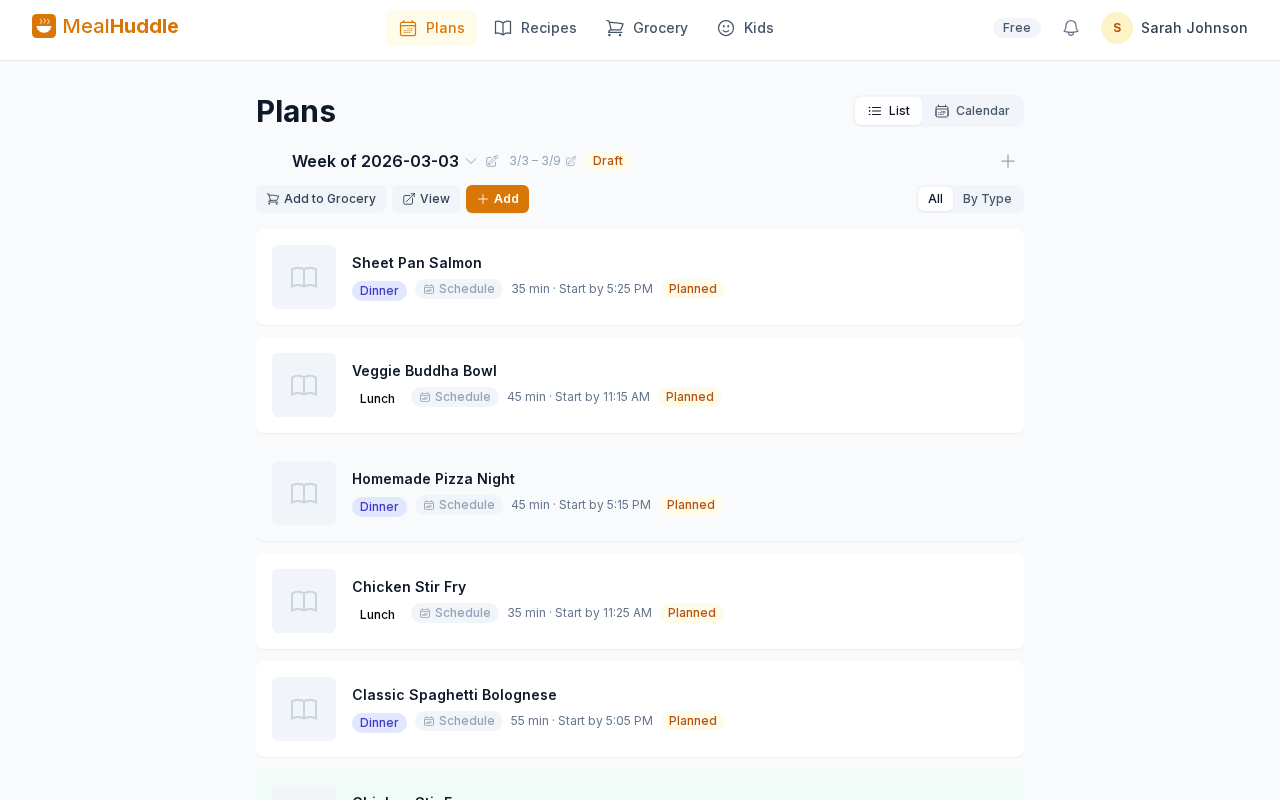
That's the gap a shared plan closes. In MealHuddle, the week's meals sit on a calendar everyone in the household can open from their own phone. The grocery list is built from the plan and sorted by store department, so whoever shops walks the aisles in order, and when someone checks off an item or marks it "already have," everyone sees it right away — no duplicate milk, no "did you get the chicken?" text. Recipes come in from a link, a photo of grandma's handwritten card, a PDF, or a quick description, so the kids' favorites are a tap away. And when Sunday's double batch of chili comes out of the oven, the leftovers wait in the Leftovers tray on the calendar until you drag them onto the night you'll eat them, without adding a thing to the grocery list.
That's the whole job of a family meal planning app: get the plan out of one head and in front of the whole household. Plenty of tools miss this by building for one person — here's why meal planning apps fail families and what to look for instead.
Making It Stick
Getting everyone on board once is easy. Keeping them there takes habits:
- Same day, same time, every week. Tie the huddle to something that already happens, like Sunday pancakes, so it becomes automatic.
- Rotate who leads. A different person runs the huddle each week. Kids love being in charge of "the plan."
- Lower the bar on bad weeks. Leftovers, breakfast-for-dinner, and one frozen pizza is still a planned week.
- Refresh the rotation every month or two. When the winners feel stale, add one new recipe a week — our family dinner ideas are a good place to look.
- Say it out loud when it works. "We didn't throw away a single thing this week" is worth announcing at the table.
The Bottom Line
Family meal prep isn't a solo sport. The households that keep it going aren't the ones with the most disciplined planner — they're the ones where everyone picked a meal, had a job, and could see the plan without asking. Start with a ten-minute huddle this weekend and hand out one job per person.
Ready to get the whole household on board? Try MealHuddle free and put this week's plan where everyone can see it.